Thursday, November 16, 2006

It's Not My Job!

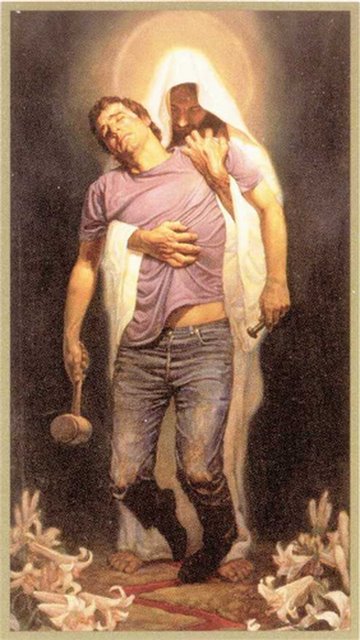
My friend Brent Whitworth sent me this picture. It is such a great insight into human laziness. "I just get paid to paint the lines...moving limbs is somebody else's job!" Striving for mediocrity. Always doing the bare minimum.

I can't even say how many times a teacher in elementary school said to us, "I don't care if that piece of trash isn't yours and you didn't throw it down...pick it up anyway!"

It's a shame sometimes that adults expect to be treated respectfully, because it would probably do us a lot of good occasionally to have someone fuss at us and say, "Stop being so self-centered!" "It doesn't matter if it isn't your fault. Step up and do the right thing because it's the right thing; not because you have to do it."

Who is going to be a good example if I am not? Who will think that Jesus can make a meaningful difference in their life if I refuse to let my life be changed? Many people's lives are monumental messes; some of their own doing entirely, some with a combination of bad parenting. If I don't have time to make someone's life better, than who will make time?

And if I'm just not willing to be the example and go the extra mile for people in real, tangible ways, then I'd be a lot better off to stop wearing the name "Christian".

James 1:27. "Religion that God our Father accepts as pure and faultless is this: to look after orphans and widows in their distress and to keep oneself from being polluted by the world." Posted by Picasa

Friday, November 10, 2006

The Dani and Nabelan-Kabelan

After the conversion of the Damal people, something very interesting happened. The Dani people were the pompous overlords of the Damal, and as all the Damal began converting enthusiastically to Christianity, they were extremely intrigued.

They sent people to the Damal to inquire about the cause of the excitement. When the reply came that the Damal were rejoicing in the fulfillment of their ancient hope, the Dani were completely shocked. They too had been awaiting the fulfillment of their own concept that they called Nabelan-Kabelan. Nabelan-Kabelan was the belief that one day immortality would return to humankind.

If the Gospel was Hai to the Damal, could it also be Nabelan-Kabelan to the Dani? Gordon and Peggy Larson had been assigned to work with the Dani. As they presented the Gospel to the Dani, it was the warriors who became the most interested. They spoke of a man named Jesus who could not only raise others from the dead, but himself as well.

Everything fell into place for the Dani just as it had for the Damal. Their ancient longing for immortality was fulfilled in Jesus Christ. The Word spread quickly from valley to valley. The once barbarous Dani people listened to the Message, they felt compunction mixed with joy, and upon their conversion they were added to the Lord's body.

The Damal and the Hai

The Damal people are located in Irian Jaya. Just a couple of decades ago, they were living in the Stone Age. There is a much more politically powerful tribe called the Dani. The Damal lived as a subservient tribe.

For who knows how long, the Damal people spoke longingly of a concept called hai. Hai was a long-anticipated golden age; a sort of Stone Age utopia where there would be no more fighting, no wars, men would stop oppressing one another, and sickness would have all but disappeared.

A Damal leader named Mugumenday had yearned all of his life to see the advent of hai. Finally he grew old, and near the end of his life, he called his son Dem to his side. He told him, "My son, hai has not come during my lifetime. Now you must watch for hai. Perhaps it will come before you die."

Completely oblivious to all of this, several years later, some missionary couples entered the Damal valley where Dem lived. They first spent time learning the Damal language, and then began to teach the gospel. Many of the Damal people thought it was polite to at least listen to their message.

One day as they were preaching to them, Dem--now a grown man--stood up and spoke, "Oh, my people, how long our forefathers waited for hai. How sadly my father died without seeing it. But now, don't you understand, these strangers have brought hai to us! We must believe their words, or we will miss the fulfillment of our ancient expectation."

As a result, nearly the entire population welcomed the Gospel. Within a few years, there was a congregation in every Damal village.

Wednesday, November 08, 2006

The Sawi "Peace Child"

Don Richardson and his wife went as missionaries to the Sawi people. They gradually learned the language, and learned more about the culture, and sought to teach them the gospel. As they studied with them through the Gospel, they were in for the shock of their lives when they saw how the Sawi people reacted to Judas' betrayal. They began laughing and really hee-hawing at what happened to Jesus, and championed Judas as the hero of the story with Jesus as the loser. They considered treachery one of the greatest virtues.

The Richardsons were very shocked and confused, and really didn't know how they were going to win these people to Christ when they had such a skewed view of what true virtue is.

In the meantime, there started to be battles between the Sawi and one of the neighboring villages. These had been sporadic in the past, but they kept getting worse and worse with no resolution. Finally, the Richardsons informed the Sawi that unless the warring stopped, they would have to move away because it wasn't safe for them anymore. The Sawi had considered it an honor to have the missionaries living among them, and took this ultimatum very seriously.

Finally, one of the leading men stepped up to make peace. The Sawi culture has a special means of making peace with an enemy tribe. A father who has a healthy baby son will take his own son and in a public gathering with the enemy, will entrust his son to an enemy father to raise the child as his own. They referred to the baby as a "Peace Child". This was an enormous sacrifice for the family and the tribe, but it was a fairly sure way to have peace.

At this very emotional and crucial juncture, Richardson found a perfect redemptive analogy. He was able to present Christ as God's "Peace Child". This resonated deeply with the Sawi, who soon began to grasp the redemptive story of God as the greatest Father, giving his one and only son for the sins of the world, to reconcile alienated people. As of today, about 70% of the Sawi are Christians.

Redemptive Analogies

I'm currently in a Global Evangelism course at Harding with Dr. Stan Granberg. Though I'm a person who cares a lot for missions, I have not taken many courses in missions. If I had to pick between a missions course and a textual or theological course, I'd pick the textual/theological stuff every time.

But the MDiv requires me to be diverse, and to learn about all different aspects of Christianity, including missions. I've said up to this point that I have not taken a single class at the grad school that has not been worth my time and money. I still maintain this stance.

I think the most interesting thing I've come across in this course is the concept of Redemptive Analogies, described by Don Richardson in the book Perspectives On The World Christian Movement.

A Redemptive Analogy is what a missionary uses as a bridge between the Gospel and one's culture. If we can find an aspect of culture that helps people appreciate the sacrifice of Jesus, then it becomes more real to them.

Jesus himself did this. All Jews would know about Moses lifting up the serpent of brass upon a pole so that the Jews, dying of snake bites, could look at it and be healed. Jesus told Nicodemus that "As Moses lifted up the serpent in the wilderness, even so must the Son of Man be lifted up, that whoever believes in Him should not perish, but have everlasting life." Jesus here used a redemptive analogy.

There are several redemptive analogies that Richardson lays out in his chapter. I think they are so cool, and I am going to make a few posts relaying some of the ones he describes. What we find over and over is that God is at work in the mission field long before we get there. Posted by Picasa

Monday, October 30, 2006

One For My Wife...

It's a lot of fun being married to a person from another country. Here's a story that has a lot of truth in it:

Once there was a mouse hole with three mice inside. One day they decided to go for a walk, but suddenly they heard a cat meowing. The mice were afraid and did not go for a walk. One of the mice listened carefully to see if the cat was still there or had left. After a long while they didn't hear any more "meows" of the cat, instead they heard a dog barking. So they all left the mouse hole. When they left, how surprised they were to see the cat there again waiting for them. The mice were not able to return to their hiding place and the cat ate them all. And the cat was very happy that he had tricked them. The cat exclaimed loudly: "How great it is to be bilingual."

Not to mention that having a bilingual wife like mine will get you preferential treatment at Mexican restaurants.

Thursday, October 19, 2006

Why Only Ask For Daily Bread?

Last Sunday night, I preached on the Lord's prayer. I have a tendency to want to shy away from doing sermon topics that everyone has already studied a gazillion times. However, the reason we tend to study certain passages multiple times is because they are really good passages, and are worth repeating. Fred Craddock once pointed out that a preacher doesn't need to only use the latter half of an unfrequently studied minor prophet to find something refreshing for his listeners. Even the 'good old' stories continue to have great meaning for us.

I sat down and read through the prayer several times. I made a little chart and tried to analyze each line from several approaches, looking for things I hadn't caught before. Following Randy Harris' advice, I tried to approach it from the angle, "If I were to take this verse as being true and necessary for my life, what does it mean I would have to do differently?"

It's a pretty powerful prayer when you stop and consider what demands you make of yourself when you pray things like, "Forgive us our debts as we forgive our debtors." If you have time, sit and read through that prayer, asking what each part of it demands of you. "What do I need to do differently in my life to be able to justifiably say this to God?"

I was particularly intrigued when I thought about the advantages of praying only for my 'daily bread'. I've seen some big crazes (such as Prayer of Jabez) where people say, "Pray that your territory will be expanded! That God will give you more and bless you more! Think of how much stuff you miss out on because you don't ask for it!" ...Yet Jesus only asked for daily bread.

So I started thinking, what if I only ask God to give me the bare essentials? "God, today I would love to have a couple of square meals to eat, and safety from any major injuries." If all I ask for is enough to get by, God's generosity very quickly becomes overwhelming.

So for the last few days, I've limited the prayer requests for myself to asking for the bare necessities. But this morning, I woke up with plenty more than what I requested. I not only have a place to lay my head; it happens to be a top-of-the-line Serta mattress with a comfy pillow (not to mention my beautiful wife sleeping next to me); located in my well-furnished bedroom, in my spacious house with an excellent heating and cooling system. I drove to work in my more-than-adequate truck listening to whatever I felt like on my iPod. Not only did I have bread to eat; I had pretty well whatever else I wanted with a variety of toppings and condiments to enhance the flavor. My health is good, my family is good, and I like my job.

What a blessed person I am. I challenge you to start only requesting what you need from God, then compare that to what he is actually giving to you, and his generosity will overwhelm you. It has me. And with such great blessings is bound to come great responsibilities...but I'll save that one for another post.

Tuesday, October 17, 2006

Happy Blogiversary!

I just had to point out that I have now been blogging for one year. It's been a lot of fun. My friend Justin at the grad school was reading these mysterious web pages by people I knew, and then he showed me his (called 'heptide') and explained to me that these things are called "Blogs". And I thought, "I'd like to try that." So now it's one year later and I've made about 170 posts, and have had over 4,000 visitors. Pretty cool! It has been a great way to keep in touch with old friends and with my family whom I don't get to see very often. I've always wanted to keep a diary, but I much prefer typing to writing, and I like the connectedness of the internet. So this is a good fit. As of right now, I have no intentions of slowing down. Perpetual Timothy will keep rocking.

Sunday, October 01, 2006

The Best Teaching Advice I've Gotten So Far

I mentioned to you all a few posts ago that I will be teaching an OT Survey at Harding this Spring, and many of you responded either on this blog or on facebook with kind words, that I have appreciated. I've asked your advice for how I should teach. I've gotten lots of clever comments, but I don't think any tops what my friend Robert sent me. Though it contains a few inside jokes, I'm attaching it for your amusement:

Hey Mark,

I haven't talked to you since learning that you got the OT teaching job at Harding. I just want to say congratulations! With that, I have a few thoughts that might help you get started.

1. The first thing you need to do is get respect from your students. On or before the first day of class, start a rumor around school that you killed a kid at your last teaching job. There are many ways to do this, such as making anonymous phone calls to students, using your underground network of friends, or making a chapel announcement. When students fear you, they'll respect you.

2. Since you are teaching Old Testament, approach your class with the understanding that nothing you teach will actually be relevant to the students. I mean, Mark, It's the OLD Testament. This is HARDING University. Not the Yom Kippur Center for Kids Who Can't Slaughter Animals Good. In fact, on your syllabus, make it clear to the students that none of the information they will be taking in during your class will ever be useful in any way, shape or form. Stapled to the back of that syllabus should be H_____'s Discourse on Jesus and Grace. Followed by D_____'s review on said discourse (Well, H_____!).

3. As far as textbooks go, there was one good one I had in mind but I keep forgetting what it's called. Wait, i think I remember now. Aww man I lost it. Maybe it'll come back later. I know you'll want to take a scholarly approach to the Old Testament, so you need look no further than the greatest OT scholar of our time, Max Lucado. I mean, seriously, if you aren't just enlightened and captivated by his superior intellect and skill, you have no soul. Oh, hey, I finally remember the name of that textbook! It's called....THE BIBLE.

All joking aside, I know you'll do a great job. I look forward to your visit in a week!
-Robert

Tuesday, September 12, 2006

From Now On You Can Call Me "Professor"

I have some news that I'm happy about. I have often thought that one day I might like to try and teach at a Christian University, but I envisioned it being when I was a middle-age guy with my PhD. It's happening much sooner than that. Harding is going to give me a chance next semester. That either says good things about me (I'm reasonably talented and a good student) or it says bad things about Harding (they're desperate for teachers). Hopefully it's more of the former.

Starting this Spring, I will be an adjunct Bible professor (I'll still be preaching full-time at Rose Bud) and will be teaching a freshmen-level Old Testament Survey class. This will give me a chance to find out several things:

1. Do I like doing this, or would I rather stick with preaching for the rest of my life? Perhaps my life will always be some of both.

2. Am I any good at this? I may try and figure out that my talents don't line up well with what's needed in a professor. I might also find out the opposite is true.

And in line with the other two, hopefully:
3. What are my long-term plans for what I will do, where I will live, and what I will study? I've debated a lot whether I should stick around this area or look for ministry opportunities at other locations.

I'm very flattered to get the chance to do this, and am extremely excited. I'm sure I'll have plenty to blog about after I get this thing going. Right now I'm working on picking out what textbook(s) I will require, and what my lesson plans will be.

For any of you who had an Old Testament Survey class, what did you like most/least about what you studied?
Is there anything I should make an extra effort to include/uninclude?
If you could only pick one or two passages from the OT that need to be studied and emphasized, what would they be?

I'm confident that this will be challenging since it's new, but I intend to work my tail off to give these kids the best class that I possibly can. Please keep me in your prayers. This is a great blessing and a great responsibility. Posted by Picasa