Carolina and I had a unique experience yesterday. About 10:00am, Jennifer Akers, a Fox 16 news reporter, called my house. She said she was trying to find the Mark Adams who had sent an e-mail to the station a few weeks ago. She had found the right guy.
I sent the news station an e-mail when they did a story about a camera man they had who had been interning with them, but was about to run out of time on his visa to keep working legally. He is an international student from Europe, and since he doesn't have a sponsor, his only choice is either to mary an American or to return home to Europe. It shed some light on how complicated it is to immigrate to the US, and I had thanked them for airing a story about it.
Most people assume that immigration is a piece of cake for someone who marries an American. When I've told people about going to Memphis for appointments at the immigration/national security headquarters, they always respond, "But yall have your marriage license; what else do they want?" I then laugh to keep myself from crying.
My main beef with the government over immigration is this: If you are going to make things easier for illegal immigrants, then make them at least that easy for me. We are already 2 years into the process of filing for one permit after another, having to renew some while waiting for others to come in. One little mistake can send a person into limbo, where it is nearly impossible to ever solve anything. I know some people who are more than 8 years into this, with no light at the end of the tunnel.
I really don't mind the idea of a worker permit for aliens, because I am sympathetic to the reasons why they come here looking for work. It just irritates me that they will be able to show up and get an easy pass while I have to hire a lawyer, spend thousands of dollars, and wait years for this, when I've done nothing wrong or illegal. In fact, if I hadn't hired a lawyer, I don't think we'd stand a chance of getting through all of this.
So Jennifer called and asked if she could come interview us. We were especially credible for this issue since I am a minister, my wife works at a Christian college, and both of us have degrees from a local Christian university. If you won't allow legal immigration for a preacher's wife, who will you allow it for?
I checked with Carolina, who agreed to do it, so Jennifer Akers and a camera man came to our house around noon and interviewed us. It was pretty cool having a big "Fox 16 News" SUV in our driveway. A lot of the clips are kind of staged, with Carolina watering a plant, and me tying a tie. They had us spend a lot of time looking through immigration papers that we spread all over our coffee table to add to the effect.
I was concerned that they might twist our words out of context or something, but I care a lot about this issue, and my desire to have my voice heard outweighed my concern for being misquoted.
If you saw the news, the little intro bits leading up to our story were horrendous, and I was terrified. "A woman from Mexico wants to stay with her husband in the United States, but immigration red tape threatens to rip this family apart!" Another was, "A woman from Mexico married to an American wants to remain here, but could she still be deported?!" We were both absolutely sick, ready to call and yell at someone, because in the interview nothing of the sort was talked about or even hinted at.
Fortunately, the story itself was very fair and accurate. They didn't twist any details or misrepresent anything we said. We requested that they didn't mention that Carolina works at Harding and that they didn't specifically mention where I preach. They respected all of our requests. I guess they use those intro clips to build up hype. We didn't care for those, but we were really happy with the main part of it.
I felt pretty special getting to be on the news; especially featured in a story about something that I care a lot about. Lots of our friends called right after the clip aired to either congratulate or make fun of us. I figure they can say whatever they want. I'm the one who got to be on TV. ;-)
This was a neat experience. As to whether or not I will do it again, I'm not sure.
To see our story, click here.
Tuesday, May 16, 2006


Friday, May 05, 2006
Natural Theology in the Old Testament
Finally. I have finished my big whopper of a paper for Dr. Fortner. I think it turned out pretty well. I basically have not spent any time with my wife in two weeks, and went to bed at 4:00 this morning, then got back up to finish it around 8:00. I just turned it in about 3:00pm. I'm happy to have it done, but now I have about a month's worth of chores needing to be done around the house.
If you've ever wondered whether natural theology played an integral part in Old Testament theology, or whether God expects you to learn some stuff about him from his creation, this is your big chance to find out. My paper is here.
If any of you do flatter me by reading this, I'd like to know what you think about it.
If you've ever wondered whether natural theology played an integral part in Old Testament theology, or whether God expects you to learn some stuff about him from his creation, this is your big chance to find out. My paper is here.
If any of you do flatter me by reading this, I'd like to know what you think about it.
Tuesday, May 02, 2006
Karl Barth and Natural Theology
One of my papers is done for the semester. It's about Karl Barth's opposition to Natural Theology. Anyone who wants to read it can see it here. I don't promise it's good, but it is what I turned in.
Monday, May 01, 2006
"How To Write A Term Paper", or "Why I've Been A Recluse For The Last Week-And-A-Half", or "Why I Wish I Could Be Justin McCreary Right Now"
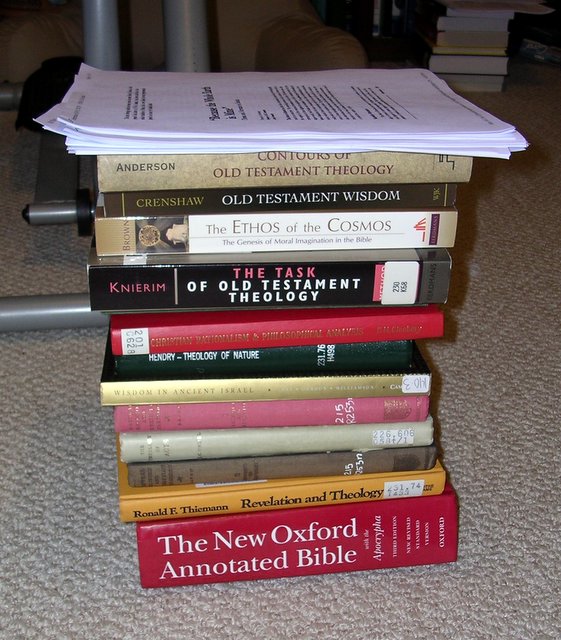


These last couple of weeks I've been finishing my assignments for the semester, which involves two beastly term papers. The top picture is what I still need to read for one of them, the middle picture is what I've read so far, divided by source, and the bottom picture is for illustrative purposes.
I have written a lot of papers over the last few years, and I'm convinced that I'm getting better at it--gradually.
For anyone reading this who wrestles a lot with term papers, I wanted to make a post and describe my tried-and-tested-and-often-revised method for writing papers. It's a lot of organization up front, but it has made the actual writing part a lot less painful for me.
Up front, a person should gather the appropriate resources. I'm going to give some directions for what someone should do once they have their resources ready to go.
1. Read your resources. As you do this, take notes on small note cards. Make one note card per source with all the publication information you will need for your bibliography. Be liberal in the quantity of note cards you take. Try to keep no more than two major ideas per card. At the top of each card, be sure to note the Author and the sequence number of the note card. (For instance, For a book by James Barr, your first card would say at the top "Barr 1", followed by "Barr 2", etc. Down in the body of the card, note the page number from where you took the note. This will all be important later.
I used to write on legal pads, but when it's time to write the paper, you can't organize legal pad notes without rewriting them somewhere else, and you spend half of your time hunting through your legal pads.
2. After you've finished reading and making note cards, you will want to categorize them into an index. This is what is on the near side of my bed in picture #2. Make a big stack of the note cards, open up a new Word document, then go through them one at a time. Analyze each card for possible categories of your paper it could relate to. I'm writing a paper on Karl Barth, so I made an index of cards that could relate to his biography, his doctrine, his influence, people opposed to his views, etc. On your word document, in bold, write the category, then under each category list the cards that relate to the category. This is why you will want to sequentially number your note cards. You might have:
Barth Biography
Barr 1
Barr 3
Miller 4
Wisnefske 13
etc.
3. After you've categorized your note cards (many of them might fit into more than one category) you will start off by making a huge bibliography. If you made a separate note card with all the bibliographic information of your sources, you can just work through the stack and enter them one at a time.
Bibliographies are all about formatting, and it is easier later if you do the work up front to find out the correct way to list all your entries. I make one huge bibliography with a detail below on the correct formatting of a footnote on the same item. (See picture #3). Now when you're typing your paper, all you have to do for footnotes and the end bibliography is copy and paste.
4. Now you take the stack of note cards which you have sorted through, and put them into small stacks on a large flat surface (like a guest bed) based on the source. (All Barr note cards in one stack, all Wisnefske's in the next, etc.)
5. Now you're ready to type! After deciding the order of your paper, choose the first topic you are addressing, then look at your index. The index will have a list of all note cards relevant to this topic, so gather them together, go over to the computer, and start typing. This is really nice because you don't have to sort through all 150 note cards over and over and over. When you go through them well once and index them, you can trust your own index to show you which ones you need for each thing.
6. Continue going through your categories, then gathering, using, and restacking the notecards until your paper is done.
I don't honestly know why I went to the trouble of writing all that out. I guess it's like the book of Proverbs. When a generation has spent their whole life learning a lesson, they desire to pass it on to younger generations so that others don't have to learn everything the hard way. I've written a lot of papers in long, dragged-out, disorganized ways. This is at least one way to do it better.

Sunday, April 30, 2006
Window Watching
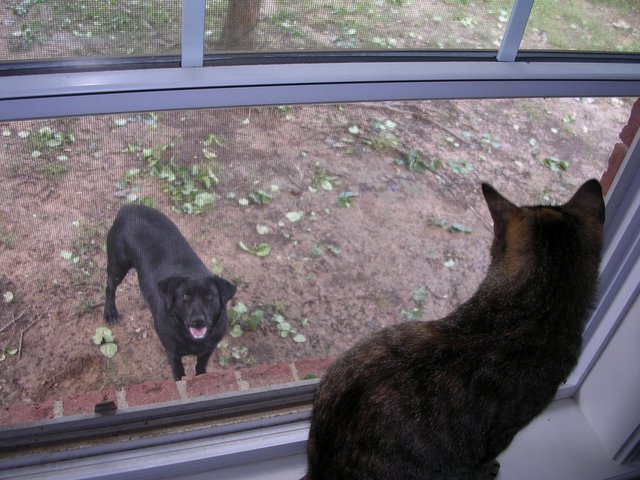
Since it is so nice outside today, we decided to open the windows and let some fresh air flow through. In the backyard, Dora became very interested when she could hear our voices at the guest room window through the screen. Nacho was right behind us to see what was going on. I thought this was a neat picture of the two of them watching each other through the window.
Thursday, April 06, 2006
Nacho & Tigger: The Saga Continues...

Today, Tigger was hanging around with Nacho. When Carolina got home, the two of them got on top of her car, and from there, jumped up onto our raised garage door. They spent several minutes trying to be sneaky up there, ready to pounce on anyone who walks by below them.
Wednesday, April 05, 2006
Modern Biblical Criticism
I happened across an essay by C.S. Lewis yesterday that really got me excited. Though I am not personally convinced by some of the more liberal biblical scholars of the last two centuries, it is hard to argue with them on a lot of points, because they readily assert they have studied the scripture more closely than you have. They try and argue what Jesus was really like or not like, or they try to classify lots of portions of Scripture in demeaning ways. C.S. Lewis writes from a unique perspective because, like the Biblical writers, people have tried to do the same thing to his works...to explain what he was thinking when he wrote what he did, or to explain what events motivated his writing and what it really meant. I could go on and summarize this article, but if you're reading my blog and you're truly interested, I'm posting it below so you can read for yourself. Maybe I'm just a weirdo who is interested in things that bore everyone else, but this essay really struck a chord with me. I think Lewis really casts some heavy doubt on guys like Bultmann.
Modern Theology and Biblical Criticism
By C. S. Lewis
The undermining of the old orthodoxy has been mainly the word of divines engaged in New Testament criticism. The authority of experts in that discipline is the authority in deference to whom we are asked to give up a huge mass of beliefs shared in common by the early church, the Fathers, the Middle Ages, the Reformers, and even the nineteenth century. I want to explain what it is that makes me skeptical about this authority. Ignorantly skeptical, as you will all too easily see. But the skepticism is the father of the ignorance. It is hard to persevere in a close study when you can work up no prima facie confidence in your teachers.
First then, whatever these men may be as biblical critics, I distrust them as critics. They seem to me to lack literary judgment, to be imperceptive about the very quality of the texts they are reading. It sounds a strange charge to bring against men who have been steeped in those books all their lives. But that might be just the trouble. A man who has spent his youth and manhood in the minute study of New Testament texts and of other people’s studies of them, whose literary experiences of those texts lacks any standard of comparison such as can only grow from a wide and deep genial experience of literature in general, is, I should think, very likely to miss the obvious things about them. If he tells me that something in a Gospel is legend or romance, I want to know how many legends and romances he has read, how well his palate is trained in detecting them by the flavor; not how many years he has spent on that Gospel. But I had better turn to examples.
In what is already a very old commentary, I read that the Fourth Gospel is regarded by one school as a “spiritual romance,” “a poem not a history,” to be judged by the same canons as Nathan’s parable, the Book of Jonah,
Then turn to John. Read the dialogues: that with the Samaritan woman at the well, or that which follows the healing of the man born blind. Look at its pictures: Jesus (if I may use the word) doodling with his finger in the dust; the unforgettable “hen de nux” (xiii, 30). I have been reading poems, romances, vision literature, legends, myths all my life. I know what they are like. I know that not one of them is like this. Of this text there are only two possible views. Either this is reportage—though it may no doubt contain errors—pretty close up to the facts; nearly as close as Boswell. Or else, some unknown writer in the second century, without known predecessors or successors, suddenly anticipated the whole technique of modern, novelistic, realistic narrative. If it is untrue, it must be narrative of that kind. The reader who doesn’t see this has simply not learned to read.
Here, from Bultmann’s Theology of the New Testament (p. 30) is another: “Observe in what unassimilated fashion the prediction of the parousia (Mk. Viii, 38) follows upon the prediction of the passion (viii, 31).” What can he mean? Unassimilated? Bultmann believes that predictions of the parousia are older than those of the passion. He therefore wants to believe—and no doubt does believe-0-that when they occur in the same passage some discrepancy or “unassimilation” must be perceptible between them.
But surely he foists this on the text with shocking lack of perception. Peter has confessed Jesus to be the Anointed One. That flash of glory is hardly over before the dark prophecy begins—that the Son of Man must suffer and die. Then this contrast is repeated. Peter, raised for a moment by his confession, makes his false step; the crushing rebuff “Get thee behind me” follows. Then, across that momentary ruin which Peter (as so often) becomes, the voice of the Master, turning to the crowd, generalizes the moral. All His followers must take up the cross. This avoidance of suffering, this self-preservation, is not what life is really about. Then, more definitely still, the summons to martyrdom. You must stand to your tackling. If you disown Christ here and now, He will disown you later. Logically, emotionally, imaginatively, the sequence is perfect. Only a Bultmann could think otherwise.
Finally, from the same Bultmann: “The personality of Jesus has no importance for the kerygma either of Paul or of John….Indeed the tradition of the earliest Church did not even unconsciously preserve a picture of his personality. Every attempt to reconstruct one remains a play of subjective imagination.”
So there is no personality of our Lord presented in the New Testament. Through what strange process has this learned German gone in order to make himself blind to what all men except him see? What evidence have we that he would recognize a personality if it were there? For it is Bultmann contra mundum. If anything whatever is common to all believers, and even to many unbelievers, it is the sense that in the Gospels they have met a personality. There are characters whom we know to be historical but of whom we do not feel that we have any personal knowledge—knowledge by acquaintance; such are Alexander, Attila, or William of Orange. There are others who make no claim to historical reality but whom, none the less, we know as we know real people: Faltstaff, Uncle Toby, Mr. Pickwick.
But there are only three characters who, claiming the first sort of reality, also actually have the second. And surely everyone knows who they are: Plato’s Socrates, the Jesus of the Gospels, and Boswell’s Johnson. Our acquaintance with them shows itself in a dozen ways. When we look into the apocryphal gospels, we find ourselves constantly saying of this or that logion, “No. It’s a fine saying, but not His. That wasn’t how He talked.”—just as we do with all pseudo-Johnsoniana.
So strong is the flavor of the personality that, even while He says things which, on any other assumption than that of divine incarnation in the fullest sense, would be appallingly arrogant, yet we—and many unbelievers too—accept Him at His own valuation when He says, “I am meek and lowly of heart.” Even those passages in the New Testament which superficially, and in intention, are most concerned with the divine, and least with the human nature, bring us face to face with the personality. I am not sure that they don’t do this more than any others.
“We beheld His glory, the glory as of the only begotten of the Father, full of graciousness and reality…which we have looked upon and our hands have handled.”? What is gained by trying to evade or dissipate this shattering immediacy of personal contact by talk about “that significance which the early church found that it was impelled to attribute to the Master”? This hits us in the face. Not what they were impelled to do but what I should call impersonality: what you’d get in a D.N. B article or an obituary or a Victorian Life and Letters of Yeshua Bar-Yosef in three volumes with photographs.
That then is my first bleat. These men ask me to believe they can read between the lines of the old texts; the evidence is their obvious inability to read (in any sense worth discussing) the lines themselves. They claim to see fern-seed and can’t see an elephant ten yards away in broad daylight.
Now for my second bleat. All theology of the liberal type involves at some point—and often involves throughout—the claim that the real behavior and purpose and teaching of Christ came very rapidly to be misunderstood and misrepresented by His followers, and has been recovered or exhumed only by modern scholars. Now long before I became interested in theology I had met this kind of theory elsewhere. The tradition of Jowett still dominated the study of ancient philosophy when I was reading Greats. One was brought up to believe that the real meaning of Plato had been misunderstood by Aristotle and wildly travestied by the new-Platonists, only to be recovered by the moderns. When recovered, it turned out (most fortunately) that Plato had really all along been an English Hegelian, rather like T.H. Green.
I have met it a third time in my own professional studies; every week a clever undergraduate, every quarter a dull American don, discovers for the first time what some Shakespearian play really meant. But in this third instance I am a privileged person. The revolution in thought and sentiment which has occurred in my own lifetime is so great that I belong, mentally, to Shakespeare’s world far more than to that of these recent interpreters. I see—I feel it in my bones—I know beyond argument—that most of their interpretations are merely impossible; they involve a way of looking at things which was not known in 1914, much less in the Jacobean period. This daily confirms my suspicion of the same approach to Plato or the New Testament.
The idea that any man or writer should be opaque to those who lived in the same culture, spoke the same language, shared the same habitual imagery and unconscious assumptions, and yet be transparent to those who have none of these advantages, is in my opinion preposterous. There is an a priori improbability in it which almost no argument and no evidence could counter-balance.
Thirdly, I find in these theologians a constant use of the principle that the miraculous does not occur. Thus, any statement put into our Lord’s mouth by the old texts, which, if He had really made it, would constitute a prediction of the future, is taken to have been put in after the occurrence that it seemed to predict. This is very sensible if we start by knowing that inspired prediction can never occur. Similarly in general, the rejection as unhistorical of all passages that narrate miracles is sensible if we start by knowing that the miraculous in general never occurs. Now I do not here want to discuss whether the miraculous is possible. I only want to point out that this is a purely philosophical question.
Scholars, as scholars, speak on it with no more authority than anyone else. The canon “If miraculous, unhistorical” is one they bring to their study of the texts, not one they have learned from it. If one is speaking of authority, the united authority of all the biblical critics in the world counts here for nothing. On this they speak simply as men—men obviously influenced by, and perhaps insufficiently critical of, the spirit of the age they grew up in.
But my fourth bleat—which is also my loudest and longest—is still to come.
All this sort of criticism attempts to reconstruct the genesis of the texts it studies; what vanished documents each author used, when and where he wrote, with what purposes, under what influences—the whole Sitz im Leben of the text. This is done with immense erudition and great ingenuity. And at first sight it is very convincing. I think I should be convinced by it myself, but that I carry about with me a charm—the herb moly—against it. You must excuse me if I now speak for a while of myself. The value of what I say depends on it being first-hand evidence.
What forearms me against all these reconstructions is the fact that I have seen it all from the other end of the stick. I have watched reviewers reconstructing the genesis of my own books in just this way.
Until you come to be reviewed yourself, you would never believe how little of an ordinary review is taken up by criticism in the strict sense: by evaluation, praise, or censure, of the book actually written. Most of it is taken up with imaginary histories of the process by which you wrote it. The very terms that the reviewers use in praising or dis-praising often imply such a history. They praise a passage as “spontaneous” and censure another as “labored”; that is, they think they know that you wrote the one currente calamo and the other invita Minerva.
What the value of such reconstructions is I learned very early in my career. I had published a book of essays; and the one into which I had put most of my heart, the one I really cared about and in which I discharged a keen enthusiasm, was on William Morris. And in almost the first review I was told that this was obviously the only one in the book in which I had felt no interest. Now don’t mistake. The critic was, I now believe, quite right in thinking it the worst essay in the book; at least everyone agreed with him. Where he was totally wrong was in his imaginary history of the causes that produced its dullness.
Well, this made me prick up my ears. Since then I have watched with some care similar imaginary histories both of my own books and of books by friends whose real history I knew. Reviewers, both friendly and hostile, will dash you off such histories with great confidence; will tell you what public events had directed the author’s mind to this or that, what other authors had influenced him, what his overall intention was, what sort of audience he principally addressed, why—and when—he did everything.
Now I must first record my impression; then, distinct from it, what I can say with certainty. My impression is that in the whole of my experience not one of these guesses has on any one point been right; that the method shows a record of 100 percent failure. You would expect that by mere chance they would hit as often as they miss. But it is my impression that they do no such thing. I can’t remember a single hit. But as I have not kept a careful record, my mere impression may be mistaken. What I think I can say with certainty is that they are usually wrong….
Now this surely ought to give us pause. The reconstruction of the history of a text, when the text is ancient, sounds very convincing. But one is after all sailing by dead reckoning; the results cannot be checked by fact. In order to decide how reliable the method is, what more could you ask for than to be shown an instance where the same method is at work and we have facts to check it by? Well, that is what I have done. And we find that when this check is available, the results are either always, or else nearly always, wrong. The “assured results of modern scholarship,” as to the way in which an old book was written, are “assured,” we may conclude, only because the men who knew the facts are dead and can’t blow the gaff. The huge essays in my own field which reconstruct the history of Piers Plowman or The Faerie Queene are most unlikely to be anything but sheer illusions.
Am I then venturing to compare every whipster who writes a review in a modern weekly with these great scholars who have devoted their whole lives to the detailed study of the New Testament? If the former are always wrong, does it follow that the latter must fare no better?
There are two answers to this. First, while I respect the learning of the great biblical critics, I am not yet persuaded that their judgment is equally to be respected. But, secondly, consider with what overwhelming advantages the mere reviewers start. They reconstruct the history of a book written by someone whose mother-tongue is the same as theirs; a contemporary, educated like themselves, living in something like the same mental and spiritual climate. They have everything to help them.
The superiority in judgment and diligence that you are going to attribute to the biblical critics will have to be almost super-human if it is to offset the fact that they are everywhere faced with customs, language, race characteristics, a religious background, habits of composition, and basic assumptions, which no scholarship will ever enable any man now alive to know as surely and intimately and instinctively as the reviewer can know mine. And for the very same reason, remember, the biblical critics, whatever reconstructions they devise, can never be crudely proved wrong. St. Mark is dead. When they meet St. Peter, there will be more pressing matters to discuss.
You may say, of course, that such reviewers are foolish in so far as they guess how a sort of book they never wrote themselves was written by another. They assume that you wrote a story as they would try to write a story; the fact that they would so try, explains why they have not produced any stories. But are the biblical critics in this way much better off? Dr. Bultmann never wrote a gospel. Has the experience of his learned, specialized, and no doubt meritorious, life really given him any power of seeing into the minds of those long-dead men who were caught up into what, on any view, must be regarded as the central religious experience of the whole human race? It is no incivility to say—he himself would admit—that he must in every way be divided from the evangelists by far more formidable barriers—spiritual as well as intellectual—than any that could exist between my readers and me.
Tuesday, April 04, 2006

Monday, April 03, 2006

Carolina and I were excited to pick up a couple of new chairs that we bought for our bedroom. There is a furniture in Little Rock called I.O. Metro that we really like. (the website is http://interior-outlet.com) The stuff is cool and they have good prices. Now we finally each have a place in the bedroom where we can put our shoes on. They also had these great rugs that are made from leather. We got this red one for the bedroom, and we'd like to get a brown one for the livingroom eventually. We finally have finished decorating our bedroom how we want it. Whenever we can save up, I guess the livingroom will be the next project.
Sunday, March 26, 2006
Mega Strawberries

We have been excited that strawberries are in season. At Wal-Mart, they had these HUGE ones. A lot of times when you get fruit that is freakishly large, it doesn't taste good, but these were fantastic. Carolina makes a fruit dip with cream cheese, brown sugar, and vanilla that is delicious on apples and strawberries.
Subscribe to:
Posts (Atom)